Many organizations successfully implement workplace improvement initiatives, but struggle to maintain the gains achieved over time. This is where the fourth step of 5S, Standardization (Seiketsu), plays a crucial role. After Sort, Set in Order, and Shine have been established, Standardization ensures that these improvements become the normal and accepted way of working across the organization.
Standardization is often considered the bridge between improvement and sustainability. Without it, workplaces can gradually drift back to old habits, leading to disorder, inefficiencies, and inconsistent performance. By creating clear standards and expectations, organizations can maintain workplace organization, cleanliness, and operational discipline on a daily basis.
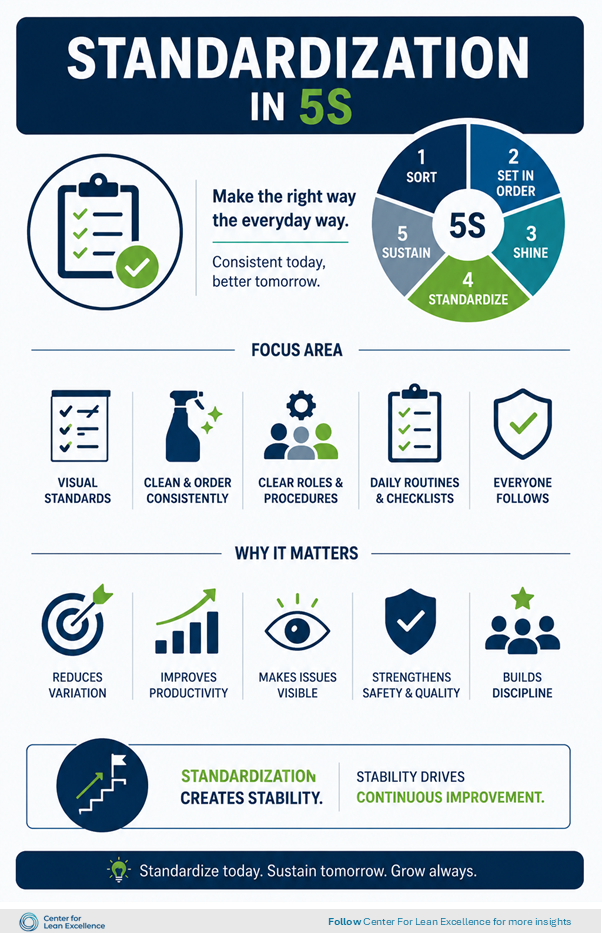
In the context of 5S, Standardization focuses on developing simple, visual, and easy-to-follow methods that help employees perform tasks consistently. The goal is not to create complex rules or excessive documentation. Instead, it is about establishing practical standards that make the desired way of working clear to everyone.
One of the key aspects of Standardization is the creation of visual standards. Visual controls such as labels, markings, shadow boards, color coding, and workplace layouts help employees quickly understand where items belong and how tasks should be performed. When visual standards are properly implemented, abnormalities become immediately visible, making it easier to identify and address issues before they escalate.
Another important focus of Standardization is maintaining workplace cleanliness and organization consistently. Cleaning and organizing should not be viewed as occasional activities performed only during audits or special events. Instead, they should become part of daily operations. Standardized cleaning schedules, inspection routines, and accountability structures help ensure that workplace conditions remain at the desired level.
Clear procedures and responsibilities are also essential components of Standardization. Every employee should understand their role in maintaining workplace standards. Defined responsibilities eliminate confusion and create ownership, ensuring that standards are sustained over time. When everyone knows what is expected and how success is measured, consistency becomes easier to achieve.
Daily routines and checklists are powerful tools that support Standardization. Simple checklists can help teams verify that critical tasks have been completed and workplace standards are being maintained. These routines encourage discipline and create a structured approach to sustaining improvements. Over time, these practices become habits that contribute to a culture of operational excellence.
The benefits of Standardization extend far beyond workplace organization. By reducing variation in how tasks are performed, organizations can improve productivity, enhance workflow consistency, and minimize errors. Employees spend less time searching for tools, materials, or information, allowing them to focus on value-adding activities.
Standardization also strengthens safety and quality. A well-organized and standardized workplace makes hazards easier to identify and eliminate. Similarly, consistent work methods reduce the likelihood of defects and quality issues, leading to more reliable outcomes and improved customer satisfaction.
Perhaps most importantly, Standardization builds a disciplined workplace culture. It reinforces the idea that excellence is not achieved through occasional efforts but through consistent daily practices. When standards are visible, understood, and followed by everyone, continuous improvement becomes easier to sustain.
It is important to recognize that Standardization is not about restricting creativity or preventing change. In fact, it provides the stable foundation needed for continuous improvement. Once a best practice has been identified and standardized, teams can focus on finding even better ways to work. New improvements can then be incorporated into updated standards, creating a cycle of ongoing progress.
Organizations that successfully embrace Standardization create workplaces that are more efficient, safer, and easier to manage. By establishing clear standards, maintaining discipline, and encouraging consistency, they lay the groundwork for long-term operational excellence.
In 5S, Standardization is not the end of the journey-it is the mechanism that ensures improvements are sustained and continuously enhanced. A well-standardized workplace creates stability today while enabling greater improvement opportunities for tomorrow.
Join with us : https://chat.whatsapp.com/Ihv7CwUYtNxGCUpSlHWUr5