Organizations often achieve impressive improvements through workplace organization initiatives. However, one of the biggest challenges is ensuring that these improvements are maintained over time. This is where the fourth step of the 5S methodology, Standardization (Seiketsu), becomes essential.
After completing the first three steps – Sort, Set in Order, and Shine – many workplaces experience noticeable gains in efficiency, cleanliness, and organization. Yet without a system to maintain these gains, employees can gradually return to old habits, causing the workplace to lose its effectiveness. Standardization bridges this gap by transforming improvements into consistent daily practices.
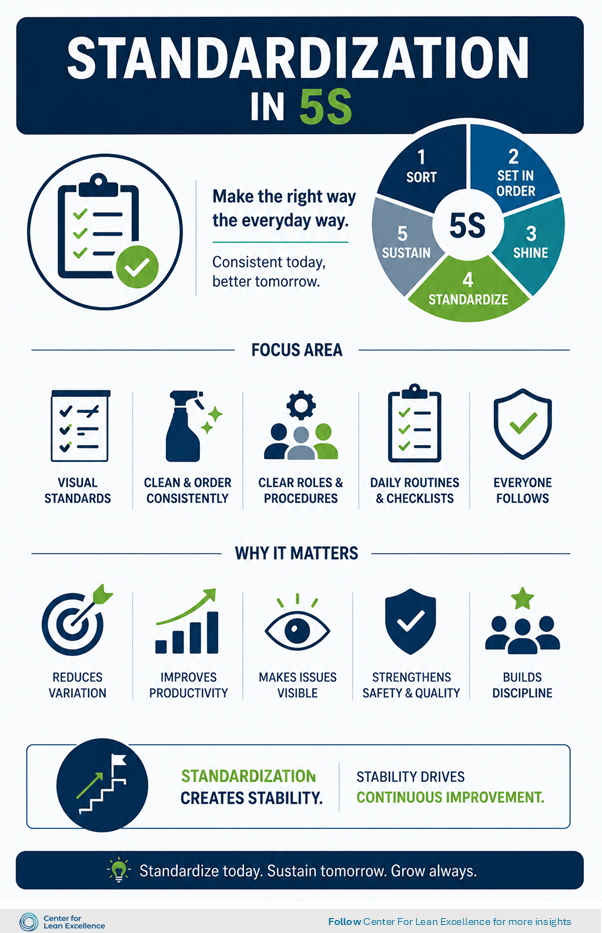
Standardization is the process of establishing clear and visible methods that ensure everyone performs tasks in the same efficient manner. It creates a common understanding of how work should be done, what conditions should be maintained, and who is responsible for sustaining them. Rather than treating workplace organization as a one-time project, standardization embeds it into the organization’s culture.
A key focus of Standardization is the creation of visual standards. Visual controls such as labels, color coding, floor markings, photographs, shadow boards, and workplace maps help employees quickly understand where items belong and how the workplace should look. These visual standards make abnormalities easy to identify and correct before they become larger problems.
Another important aspect is maintaining cleanliness and order consistently. Through defined cleaning schedules, inspection routines, and accountability systems, organizations ensure that the workplace remains organized every day not just during audits or special improvement events. Regular maintenance of workplace standards prevents deterioration and supports operational stability.
Standardization also involves developing clear procedures and assigning responsibilities. Employees need to know exactly what is expected of them and how their activities contribute to sustaining workplace excellence. Standard operating procedures, work instructions, and responsibility matrices help eliminate uncertainty and ensure consistency across teams and shifts.
Daily routines and checklists play a critical role in sustaining standards. Simple checklists for cleaning, inspections, and workplace organization encourage employees to verify conditions regularly. These routines create discipline and make standardization a natural part of daily operations rather than an additional task.
One of the greatest benefits of Standardization is the reduction of variation. When everyone follows the same best practice, work becomes more predictable, efficient, and reliable. Employees spend less time searching for tools, materials, or information, resulting in smoother workflows and improved productivity.
Standardization also makes abnormalities immediately visible. When a workplace has clearly defined standards, any deviation stands out. Missing tools, misplaced materials, equipment leaks, damaged labels, or unsafe conditions become easier to detect and address quickly. This early detection prevents minor issues from developing into major operational problems.
Safety and quality performance are also strengthened through standardization. Organized workplaces reduce the risk of accidents, while consistent procedures minimize errors and defects. Employees can perform their tasks with greater confidence because expectations are clear and workplace conditions remain stable.
Importantly, standardization should not be viewed as a restriction on creativity or improvement. Instead, it provides a stable foundation from which continuous improvement can thrive. Once a best practice is established and standardized, teams can focus on identifying even better ways of working. Each improvement then becomes the new standard, creating a cycle of ongoing development and operational excellence.
In today’s competitive business environment, sustainable success requires more than temporary improvements. Organizations must build systems that maintain and strengthen progress over time. Standardization ensures that workplace organization, efficiency, safety, and quality become permanent features of daily operations.
Ultimately, Standardization in 5S is about creating consistency, discipline, and accountability. By establishing clear standards and ensuring they are followed every day, organizations can sustain improvements, support continuous improvement efforts, and build a culture of excellence that delivers long-term results.
Join with us : https://chat.whatsapp.com/Ihv7CwUYtNxGCUpSlHWUr5