Workplace safety is often measured by the number of accidents that occur. However, truly safe organizations understand that the biggest opportunities for improvement exist before an accident happens. One of the most valuable indicators of future risk is the near miss.
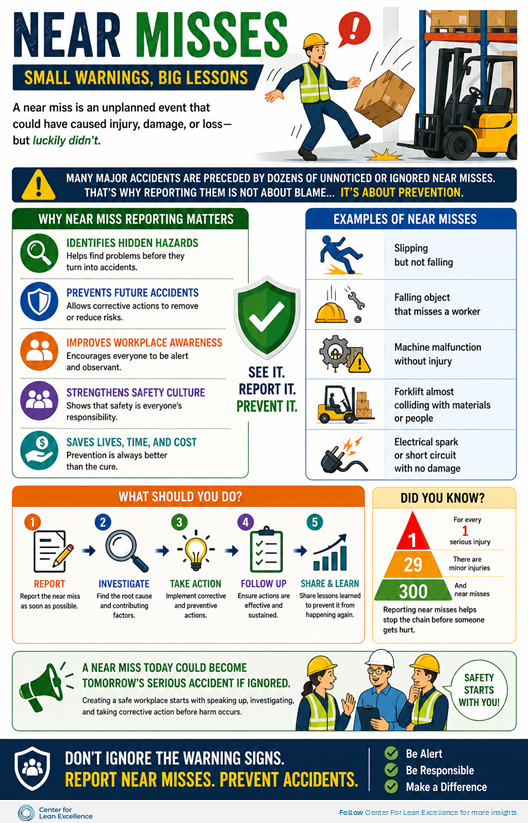
A near miss is an unplanned event that could have resulted in injury, property damage, equipment failure, environmental impact, or financial loss but fortunately did not. Although there are no immediate consequences, a near miss should never be dismissed as “nothing happened.” Instead, it should be viewed as a warning sign that a hazard exists and that corrective action is needed.
In Lean thinking and modern safety management, every near miss is an opportunity to learn, improve, and prevent a more serious incident in the future.
Understanding the Importance of Near Misses
Many workplace accidents do not happen without warning. They are often preceded by numerous small incidents, unsafe conditions, or unsafe behaviors that go unnoticed or unreported.
This concept is reflected in the Heinrich Principle, which suggests that for every major injury, there are many minor injuries and hundreds of near misses or unsafe acts. While the exact ratio may vary across industries, the message remains the same: major accidents are rarely isolated events they are usually the result of ignored warning signs.
Every near miss provides valuable information about weaknesses in equipment, processes, procedures, training, or workplace conditions. Organizations that capture and learn from these events are far more likely to prevent future accidents.
Why Near Miss Reporting Matters
Reporting near misses is not about assigning blame or identifying who made a mistake. It is about understanding why the event occurred and preventing it from happening again.
A strong near miss reporting system helps organizations:
- Identify hidden workplace hazards before they cause harm.
- Prevent injuries, equipment damage, and operational disruptions.
- Improve employee awareness of workplace risks.
- Strengthen the overall safety culture.
- Reduce investigation costs, downtime, and insurance claims.
- Encourage proactive rather than reactive safety management.
Instead of waiting for an accident to expose a problem, organizations can take preventive action while the risk is still manageable.
Common Examples of Near Misses
Near misses occur in every workplace, regardless of industry. Some examples include:
- An employee slips on a wet floor but regains balance without falling.
- A tool falls from height but narrowly misses a worker.
- A forklift almost collides with stored materials or pedestrians.
- A machine unexpectedly stops or malfunctions without causing injury.
- An electrical spark occurs without starting a fire.
- A chemical container leaks but is discovered before exposure occurs.
- A load shifts while being lifted but is safely controlled before falling.
Although these incidents may seem minor, they reveal hazards that could eventually lead to serious consequences if ignored.
Creating a Culture of Reporting
One of the biggest challenges organizations face is encouraging employees to report near misses. Many workers hesitate because they fear blame, criticism, or unnecessary paperwork.
To overcome this, leaders must create a Just Culture an environment where employees feel comfortable reporting safety concerns without fear of punishment.
Successful organizations encourage employees to:
- Report every near miss immediately.
- Focus on facts rather than blame.
- Participate in investigations.
- Suggest practical improvements.
- Share lessons learned with others.
When employees understand that reporting contributes to everyone’s safety, participation naturally increases.
Investigating Near Misses
Reporting a near miss is only the first step. The real value comes from investigating the event to identify its root cause.
Instead of asking, “Who made the mistake?”, organizations should ask:
- What happened?
- Why did it happen?
- What conditions allowed it to occur?
- What can be improved to prevent recurrence?
Using structured problem-solving methods such as the 5 Whys, Fishbone Diagram, or A3 Problem Solving helps teams identify the true causes rather than simply treating the symptoms.
Corrective actions should focus on eliminating hazards, improving procedures, strengthening training, and enhancing workplace controls.
The Business Benefits of Near Miss Reporting
Near miss reporting is not only about compliance it also creates measurable business value.
Organizations with strong reporting systems often experience:
- Fewer workplace injuries
- Lower maintenance costs
- Reduced production downtime
- Improved employee engagement
- Better operational reliability
- Increased customer confidence
- Stronger organizational learning
Every prevented accident saves far more than the cost of responding to one. Protecting people also protects productivity, quality, and business performance.
Everyone Has a Role to Play
Safety is not the responsibility of the safety department alone. Every employee, supervisor, manager, and leader contributes to creating a safer workplace.
A culture where employees openly report hazards, discuss risks, and continuously improve processes is far more resilient than one that reacts only after accidents occur.
Every reported near miss becomes a lesson for the entire organization, helping prevent future injuries and building trust among employees.
Final Thoughts
Near misses may seem insignificant because no one gets hurt, but they are among the most valuable sources of information for preventing accidents. They reveal hidden risks, expose process weaknesses, and provide organizations with the opportunity to improve before harm occurs.
The difference between a near miss and a serious accident is often one missed opportunity to learn.
By encouraging reporting, investigating every event, and implementing effective corrective actions, organizations can build a proactive safety culture where prevention becomes everyone’s responsibility.
Remember, every near miss is a gift it gives us the chance to improve before someone gets injured.
Don’t ignore the warning signs. Report near misses, learn from them, and create a safer workplace for everyone.