In every manufacturing environment, problems exist. The difference between world-class manufacturers and average ones is not the absence of problems it is how quickly they identify and respond to them.
One of the most common reasons organizations experience equipment failures, quality defects, production delays, and workplace accidents is that small abnormalities go unnoticed or are simply ignored. What starts as a minor issue today can easily become a costly breakdown tomorrow.
Lean Manufacturing teaches us a powerful principle: make abnormalities visible immediately. This is exactly where the Fuguai Tag plays an essential role.
What is a Fuguai Tag?
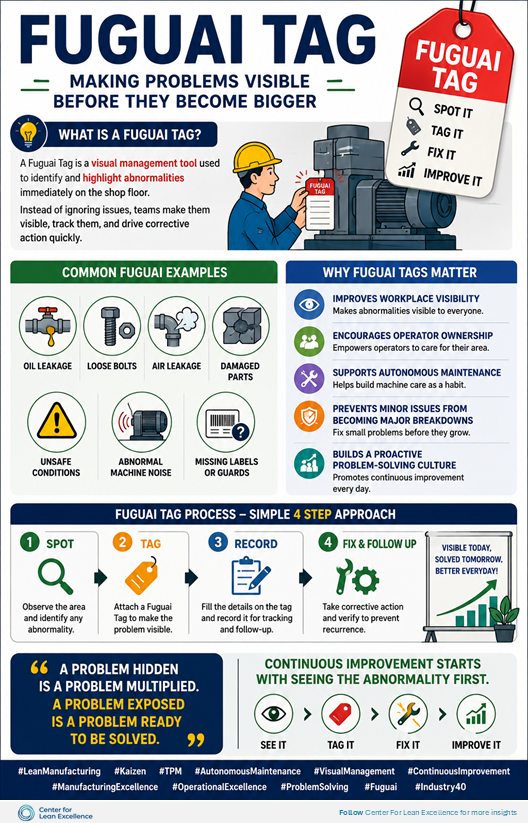
A Fuguai Tag is a visual management tool used to identify and highlight abnormalities on the shop floor. Rather than allowing defects or equipment issues to remain hidden, operators attach a clearly visible tag to the abnormal condition, ensuring everyone is aware of the issue and that corrective action can begin without delay.
The word Fuguai comes from Japanese Lean practices and refers to an abnormality or defect that deviates from the expected condition. By making these abnormalities visible, organizations prevent them from becoming larger operational problems.
Instead of asking, “Who caused this problem?”, Lean encourages teams to ask, “How can we solve this problem before it grows?” Fuguai Tags help create this proactive mindset.
Common Examples of Fuguai
Fuguai Tags can be applied to virtually any abnormal condition observed in the workplace. Some common examples include:
- Oil leakage from hydraulic systems
- Loose bolts or fasteners
- Air leakage in pneumatic equipment
- Damaged machine components
- Unsafe working conditions
- Unusual machine noise or vibration
- Missing safety guards
- Missing labels or identification tags
- Electrical wiring damage
- Housekeeping issues that create safety risks
Many of these issues may appear insignificant individually. However, if left unattended, they can eventually lead to machine failures, production interruptions, quality defects, increased maintenance costs, or even serious workplace accidents.
Why Fuguai Tags Matter
1. They Improve Workplace Visibility
One of the biggest enemies of continuous improvement is hidden problems.
Without visual indicators, abnormalities are often forgotten during busy production schedules. A Fuguai Tag immediately draws attention to an issue, ensuring it cannot be overlooked.
Visible problems become visible priorities.
2. They Encourage Operator Ownership
Operators are closest to the process and are usually the first to notice abnormalities.
By empowering operators to attach Fuguai Tags whenever they observe an issue, organizations create a culture where everyone contributes to equipment reliability and workplace safety.
Employees become active problem identifiers rather than passive observers.
3. They Support Autonomous Maintenance
Fuguai Tags are a key element of Autonomous Maintenance, one of the core pillars of Total Productive Maintenance (TPM).
Operators perform routine inspections, cleaning, lubrication, and minor maintenance while identifying abnormalities before they become serious equipment failures.
This collaboration between production and maintenance teams significantly improves machine reliability and equipment availability.
4. They Prevent Major Breakdowns
Most catastrophic equipment failures do not happen suddenly.
They usually begin with small warning signs a loose bolt, a minor oil leak, an unusual sound, or slight vibration.
When these early symptoms are ignored, they gradually develop into expensive breakdowns that require significant repair time and production loss.
A simple Fuguai Tag can prevent hours or even days of downtime.
5. They Build a Proactive Problem-Solving Culture
Organizations committed to Lean thinking do not wait for failures to happen.
Instead, they actively search for abnormalities every day.
Using Fuguai Tags encourages employees to identify issues immediately, communicate them openly, and collaborate to eliminate root causes. Over time, this develops a workplace culture focused on prevention rather than reaction.
Continuous improvement begins with recognizing that every abnormality is an opportunity to improve.
Best Practices for Using Fuguai Tags
To maximize the effectiveness of Fuguai Tags, organizations should establish a simple but disciplined process:
- Encourage every employee to report abnormalities without fear of blame.
- Use standardized Fuguai Tags that are easy to identify.
- Record each abnormality in a tracking system.
- Assign ownership for corrective action.
- Prioritize issues based on safety, quality, delivery, and equipment risk.
- Verify that corrective actions are completed.
- Analyze recurring abnormalities to eliminate root causes permanently.
A Fuguai Tag should never become permanent decoration on a machine. Its purpose is to trigger action—not simply identify problems.
Final Thoughts
Lean Manufacturing is built on the belief that every problem is an opportunity for improvement. The earlier an abnormality is detected, the easier and less expensive it is to eliminate.
Fuguai Tags transform hidden issues into visible improvement opportunities. They strengthen visual management, improve equipment reliability, enhance safety, support Autonomous Maintenance, and foster a culture where everyone takes responsibility for continuous improvement.
Remember this simple but powerful Lean principle:
“A problem hidden is a problem multiplied. A problem exposed is a problem ready to be solved.”
The journey toward operational excellence doesn’t begin with expensive technology or major investments. It begins with observing the workplace carefully, identifying abnormalities, and taking immediate action.
Because continuous improvement always starts by seeing what others choose to ignore.
Join with us : https://www.linkedin.com/company/31030242