In today’s competitive business environment, organizations continuously strive to improve productivity, reduce costs, and deliver superior value to customers. However, one hidden challenge quietly erodes profits and operational performance every day machine downtime.
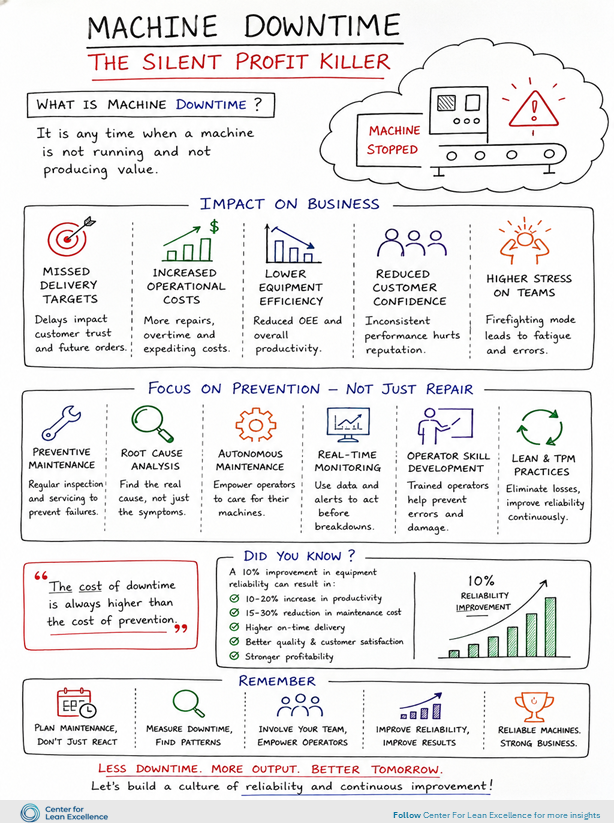
Machine downtime occurs whenever equipment is unable to perform its intended function. Whether caused by breakdowns, changeovers, maintenance delays, material shortages, or operational issues, downtime directly impacts production output and business performance. While a machine may appear idle for only a few minutes, the cumulative effect can be significant.
Every minute a machine stands still represents lost production opportunities. Products are not being manufactured, customer orders are delayed, and valuable resources remain underutilized. What often appears to be a simple maintenance issue is actually a business issue with far-reaching consequences.
The Real Cost of Machine Downtime
Many organizations underestimate the true cost of downtime because they focus only on repair expenses. In reality, downtime creates multiple layers of loss throughout the operation.
Missed Delivery Targets
Customers expect products to be delivered on time. When machines fail unexpectedly, production schedules are disrupted, resulting in delayed shipments and missed commitments. Frequent delays can damage customer relationships and impact future business opportunities.
Increased Operational Costs
Unplanned downtime often requires emergency maintenance, overtime labor, expedited material shipments, and additional troubleshooting efforts. These costs can quickly accumulate and significantly impact profitability.
Lower Equipment Efficiency
Equipment effectiveness decreases when machines frequently stop and restart. Reduced availability directly impacts Overall Equipment Effectiveness (OEE), limiting the organization’s ability to maximize asset utilization.
Reduced Customer Confidence
Reliability is a critical factor in customer satisfaction. Consistent delivery failures caused by equipment breakdowns can reduce customer trust and encourage them to seek alternative suppliers.
Higher Stress on Teams
Unexpected downtime places additional pressure on operators, maintenance teams, planners, and supervisors. Teams are forced into reactive firefighting mode instead of focusing on continuous improvement and long-term performance enhancement.
Moving from Reactive to Proactive
World-class organizations understand that preventing downtime is far more effective than responding to breakdowns. Instead of waiting for failures to occur, they build systems and processes that improve equipment reliability and stability.
Preventive Maintenance
Preventive Maintenance involves regularly scheduled inspections, servicing, and replacement of components before failure occurs. This proactive approach helps identify potential problems early and reduces the likelihood of unexpected breakdowns.
Root Cause Analysis
Fixing a machine without understanding why it failed often leads to repeated issues. Root Cause Analysis helps organizations identify the underlying causes of failures and implement permanent corrective actions. Techniques such as 5 Whys, Fishbone Diagrams, and A3 Problem Solving are valuable tools for eliminating recurring downtime.
Autonomous Maintenance
Operators are the first line of defense against equipment deterioration. Through Autonomous Maintenance, operators perform routine cleaning, inspection, lubrication, and minor adjustments. This increases equipment ownership and enables early detection of abnormalities.
Real-Time Monitoring
Modern manufacturing systems increasingly use sensors, dashboards, and digital monitoring tools to track machine performance. Real-time monitoring allows organizations to identify issues immediately and respond before small problems become major failures.
Operator Skill Development
Even the most advanced equipment requires skilled operators. Investing in training improves troubleshooting capabilities, operating discipline, and adherence to standard procedures, all of which contribute to higher equipment reliability.
Lean and TPM Practices
Lean Manufacturing and Total Productive Maintenance (TPM) provide structured approaches for improving equipment performance. TPM focuses on maximizing equipment effectiveness by involving everyone—from operators to management—in maintaining and improving assets.
Small Improvements Create Big Results
Organizations often search for major investments to improve productivity, but some of the greatest gains come from reducing downtime. A small reduction in machine stoppages can significantly increase output capacity without purchasing additional equipment.
Improved machine reliability leads to:
- Higher productivity
- Better equipment utilization
- Lower operating costs
- Improved delivery performance
- Increased customer satisfaction
- Greater profitability
The cumulative effect of small reliability improvements can transform overall business performance.
Conclusion
Machine downtime is one of the most overlooked threats to profitability. Every minute of unplanned stoppage represents lost production, increased costs, and potential customer dissatisfaction. Organizations that prioritize equipment reliability gain a significant competitive advantage through improved efficiency and operational stability.
The key is simple: focus on prevention rather than reaction. By implementing preventive maintenance, root cause analysis, autonomous maintenance, real-time monitoring, operator development, and TPM practices, businesses can dramatically reduce downtime and unlock hidden productivity.
Remember:
“The cost of downtime is always higher than the cost of prevention.”
Investing in reliability today creates sustainable productivity, stronger customer relationships, and long-term profitability tomorrow.