Imagine walking into a workplace where you can immediately understand what is happening without asking a single question. Production status is visible, safety zones are clearly marked, tools are in their designated locations, and any abnormality stands out instantly. This is the essence of Visual Management a Lean principle that transforms information into simple visual cues, enabling everyone to make faster and better decisions.
Visual Management is more than placing signs or labels around a workplace. It is a systematic approach to communicating important information through visual signals such as colors, symbols, boards, markings, tags, and indicators. The objective is simple: make the workplace “speak” so that employees can quickly recognize normal conditions, identify abnormalities, and respond without unnecessary delays or lengthy explanations.
One of the greatest advantages of Visual Management is its ability to eliminate confusion. In many organizations, valuable time is lost because employees spend time searching for tools, clarifying instructions, or waiting for information. When expectations and standards are displayed visually, everyone understands what should happen, what is happening, and what requires attention. This creates a more organized, efficient, and productive workplace.
Visual Management also plays a critical role in improving communication. Instead of relying solely on verbal instructions or written reports, visual tools provide real-time information that everyone can understand regardless of their role or experience. Whether it is a production target, machine status, safety alert, or quality issue, visual displays ensure that the right information reaches the right people at the right time.
Another major benefit is the ability to identify abnormalities immediately. In Lean Manufacturing, problems should never remain hidden. Visual indicators make deviations from the standard obvious, allowing teams to respond before small issues become costly problems. Faster detection leads to quicker corrective actions, reducing downtime, defects, delays, and safety risks.
Visual Management also strengthens workplace safety. Clearly marked walkways, hazard zones, emergency exits, storage locations, and safety instructions reduce the likelihood of accidents and create a more disciplined working environment. When employees can instantly recognize safe and unsafe conditions, they are more likely to follow standard procedures and maintain an organized workplace.
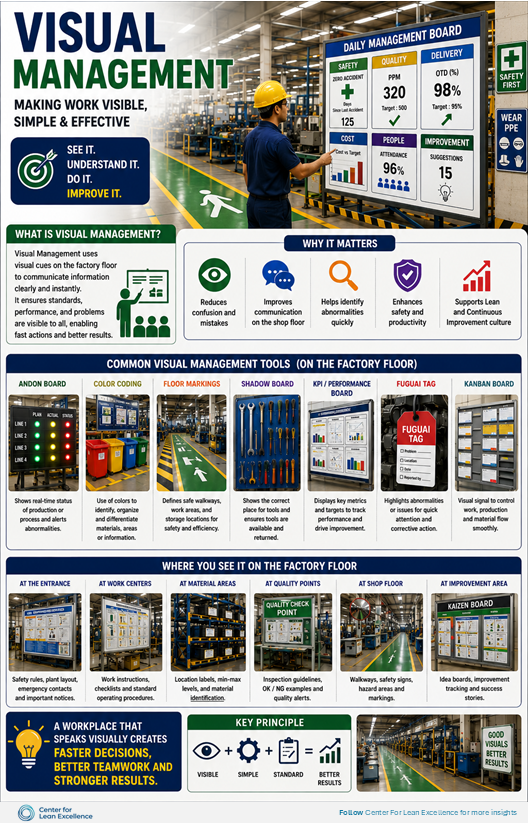
Many organizations successfully use a variety of Visual Management tools to support daily operations. Some of the most common include:
- Andon Boards – Display production status and alert teams to operational issues.
- Color Coding – Differentiate products, materials, tools, or safety zones for quick identification.
- Shadow Boards – Clearly indicate where every tool belongs, making missing items immediately visible.
- Floor Markings – Define work areas, storage locations, pedestrian walkways, and material flow.
- KPI Boards – Display real-time performance indicators to monitor progress against targets.
- Fuguai Tags – Highlight abnormalities requiring corrective action.
- Kanban Cards – Enable visual control of inventory and material replenishment.
When implemented effectively, these tools create transparency throughout the organization. Employees no longer spend time searching for information because the workplace itself communicates the current situation. As a result, decision-making becomes faster, teamwork improves, and accountability increases across all levels of the organization.
However, successful Visual Management is not about filling the workplace with signs and labels. Every visual should have a clear purpose, be easy to understand, and support the flow of work. Simplicity is the key. A cluttered workplace with excessive visual information can create confusion rather than clarity.
Organizations pursuing Lean transformation should view Visual Management as a fundamental building block rather than a decorative initiative. When combined with standardized work, 5S, Kaizen, and continuous improvement, it creates a workplace where abnormalities are visible, problems are solved quickly, and operational excellence becomes part of the daily culture.
As the Lean philosophy reminds us:
“What gets visualized gets managed better.”
A workplace that communicates visually empowers people to make quicker decisions, collaborate more effectively, and continuously improve performance creating greater value for both the organization and its customers.