
Understanding Japan Through Its Places: A Holistic View of Culture, Environment, and Experience. Traveling to Japan is often described as stepping into a world where tradition and modernity coexist seamlessly. Many visitors explore iconic destinations, take photographs, and experience the culture briefly. Yet despite these experiences, a common reality remains: most travelers only scratch the surface of what places across Japan truly represent.
This is not due to a lack of curiosity. Visitors are eager to learn, observe, and engage. Moreover, understanding significant places like Japan requires more than sightseeing, it requires more attention to how environments function, how people interact, and how everyday experience are shaped across different cities like Tokyo, Osaka, Kyoto, Nagoya and Sendai.
Across Japan, places are not simply destinations; they are reflections of cultural values, behavioral patterns, and historical continuity. From highly structured urban environments to quiet, reflective cultural spaces, each setting contributes to a broader understanding of the country. When exploring those regions, they reveal how Japan balances complexity with harmony, efficiency with mindfulness, and innovation with preservation.
Below are five key perspectives that help us understand how places across Japan shape a deeper understanding of the nation.
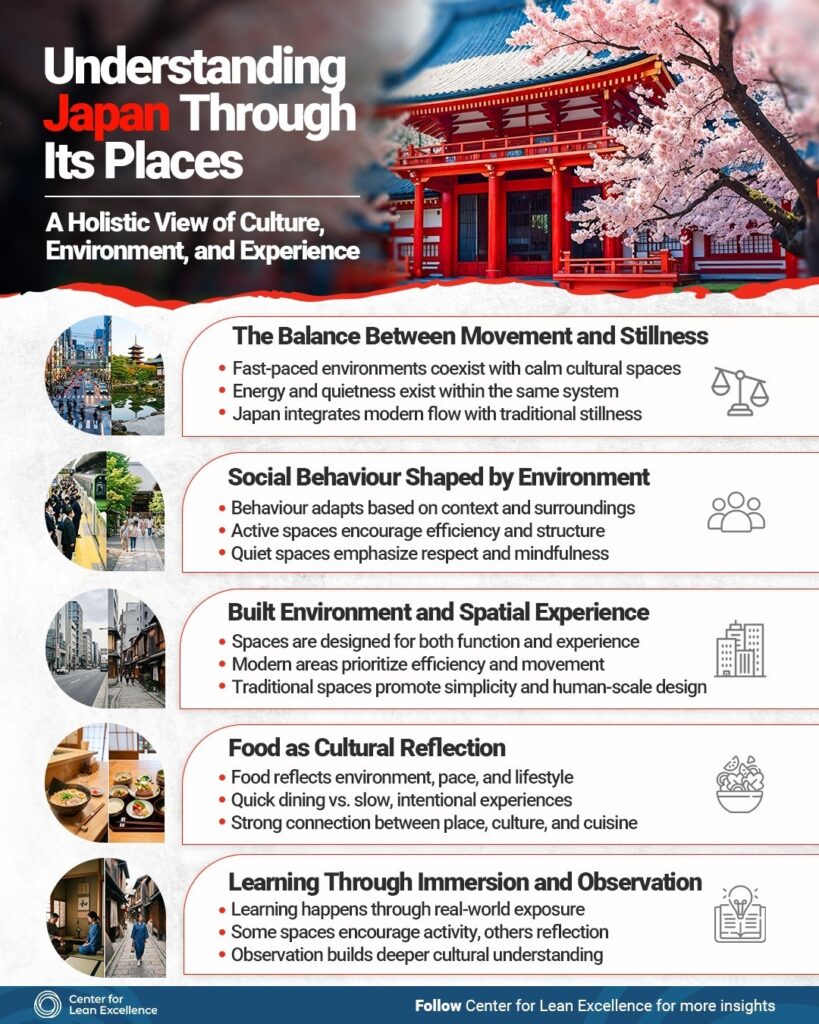
1. The Balance Between Movement and Stillness
One of the most defining characteristics of places across Japan is the balance between energy and calmness. Some environments are fast-paced, structured, and driven by efficiency, while others are slow, quiet, and deeply rooted in tradition.
This contrast does not fragmented, it exists as a continuous experience across the country. Rather than separating modern and traditional elements, Japan integrates them within its environments. This allows individuals to transition seamlessly between different experiences within the same cultural framework.
Understanding this balance helps reveal how Japan maintains its identity while continuously evolving.
2. Social Behaviour Shaped by Environment
Behaviour in Japan is highly adaptive and influenced by surroundings. In more active environments, interactions tend to be efficient, purposeful, and structured. In quieter or culturally significant settings, behaviour shifts towards mindfulness, respect, and subtle communication.
This demonstrates that behaviour is not uniform across Japan. Instead, it aligns closely with context and environment. People adjust naturally based on expectations embedded within each place.
Recognizing this adaptability provides deeper insight into how social harmony is maintained across diverse environments.
3. Built Environment and Spatial Experience
The design of places in Japan plays a critical role in shaping how people move, interact, and experience daily life. Environments are carefully structured to support both functionality and cultural expression.
Modern spaces often emphasize organization, accessibility, and efficiency. In contrast, traditional settings prioritize simplicity, natural materials, and human-scale design. These spaces encourage slower movement and deeper engagement with surroundings.
This intentional approach to design shows that places in Japan are not just built for use, which they are designed to guide behaviour and influence experience.
4. Food as Cultural Reflection
Food culture in Japan reflects the identity of different environments. In more dynamic settings, food is often quick, accessible, and socially encouraging interaction and shared experiences. In more traditional or reflective environments, food becomes intentional, seasonal, and carefully presented.
This variation highlights that food is deeply connected to place. It reflects not only local ingredients and preparation methods but also the pace, purpose, and cultural values of the environment.
Understanding food in this context provides a more meaningful perspective on how daily life is experienced across Japan.
5. Learning Through Immersion and Observation
Places across Japan offer diverse learning experiences. Some environments encourage active participation through movement, interaction, and exploration. Others promote reflection through cultural practices, rituals, and historical continuity.
Learning in Japan is not always structured. They are mostly occured through immersion. Observing how people behave, how spaces are used, and how systems function provides valuable insights into the country’s way of life.
This combination of active and reflective learning creates a well-rounded understanding of Japan that extends beyond traditional travel experiences.
Conclusion: Understanding Japan Through Its Places
Understanding Japan requires more than visiting landmarks or following itineraries. It requires awareness of how places shape behaviour, influence interaction, and reflect cultural values.
Across the country, each environment contributes to a broader narrative. Together, these places form an interconnected system where tradition and modernity coexist, and where daily experiences reflect emotional cultural principles.
By focusing on places rather than individual destinations, travel becomes more than exploration. It becomes a process of learning.
For those looking to experience this perspective firsthand, the TPS Japan Mission program offers a structured opportunity to travel to Japan and explore these regions on transforming observation into practical understanding.
Through this approach, Japan can be understood not just as a location, but as a collection of experiences that together define its identity.