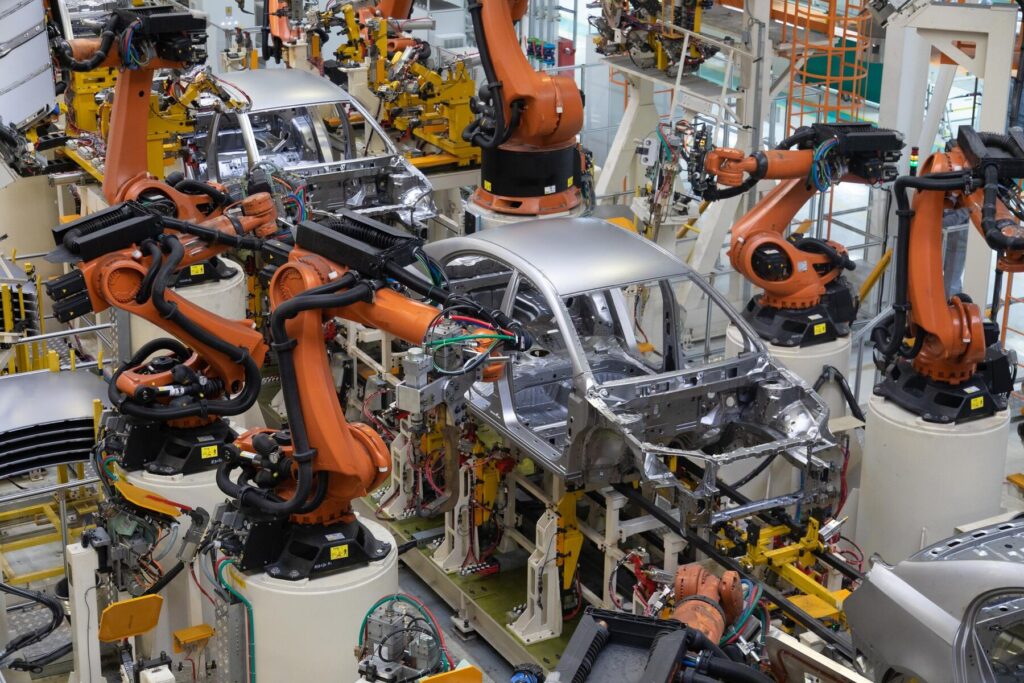
In world-class manufacturing systems, equipment reliability is not achieved by maintenance teams alone. True reliability is built at the source of operation—on the shopfloor, by the people who use the machines every day. This is the core philosophy behind Autonomous Maintenance (AM), also known as Jishu Hozen, a key pillar of Total Productive Maintenance (TPM).
Autonomous Maintenance shifts the traditional boundaries of responsibility. Instead of operators only running machines and maintenance teams fixing them when they fail, AM creates a shared ownership culture where operators actively participate in maintaining equipment condition. This approach strengthens reliability, improves efficiency, and builds a proactive mindset across the organization.
What Autonomous Maintenance Focuses On
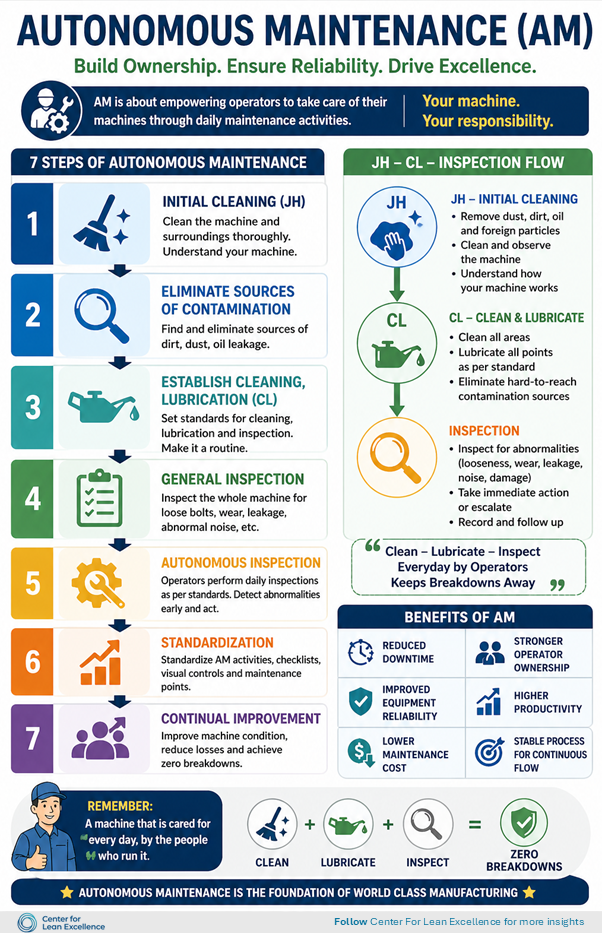
Autonomous Maintenance is built on simple but powerful practices that create long-term impact:
- Cleaning equipment to expose hidden defects
- Lubrication and tightening to maintain basic machine condition
- Early detection of abnormalities such as noise, leakage, vibration, or temperature variation
- Standardized inspection routines to ensure consistency
- Developing operator skills, awareness, and ownership mindset
These activities may appear basic, but their impact is transformational. Cleaning alone becomes a diagnostic tool. When machines are cleaned properly, hidden issues become visible, allowing early action before failures occur.
The Mindset Shift: Ownership at the Core
One of the most important outcomes of Autonomous Maintenance is the mindset transformation it creates.
It moves people from:
“I operate the machine”
to
“I take care of the machine”
This shift is not just semantic—it is cultural. Operators begin to see equipment as something they are responsible for, not just something they use. This sense of ownership encourages attention to detail, pride in work, and accountability for machine condition.
When this mindset becomes part of daily routine, the shopfloor evolves from a reactive environment to a proactive one.
The Role of Early Detection
A key strength of AM is early detection of abnormalities. Small issues such as oil leaks, unusual noise, loose bolts, or vibration are often early warning signs of bigger failures.
In traditional systems, these signals may go unnoticed until breakdown occurs. However, under Autonomous Maintenance, operators are trained to identify and act on these early indicators. This prevents minor issues from escalating into major downtime events.
In this way, cleaning and inspection become powerful tools of prevention rather than correction.
Key Benefits of Autonomous Maintenance
When implemented effectively, AM delivers significant operational advantages:
- Improved equipment reliability through daily care
- Reduced breakdowns and minor stops due to early intervention
- Stronger operator engagement and responsibility
- Higher productivity driven by preventive practices
- A solid foundation for TPM excellence and continuous improvement
Beyond technical improvements, AM also strengthens teamwork between operators and maintenance teams. Maintenance professionals can focus on advanced technical work, while operators handle basic care and monitoring.
Building a Culture, Not Just a Process
Autonomous Maintenance is not simply a set of activities. It is a long-term cultural transformation. It builds discipline, awareness, and ownership at every level of the organization.
When operators consistently care for their machines, reliability is no longer dependent on reaction to failure-it becomes a daily habit embedded in the system. This cultural shift is what drives sustainable manufacturing excellence.
Conclusion
Autonomous Maintenance is a powerful enabler of shopfloor ownership. By empowering operators to care, inspect, and maintain their equipment, organizations unlock higher reliability and stronger engagement.
Ultimately, AM creates a workplace where machines are not just operated-they are respected, maintained, and continuously improved by the people who use them every day.