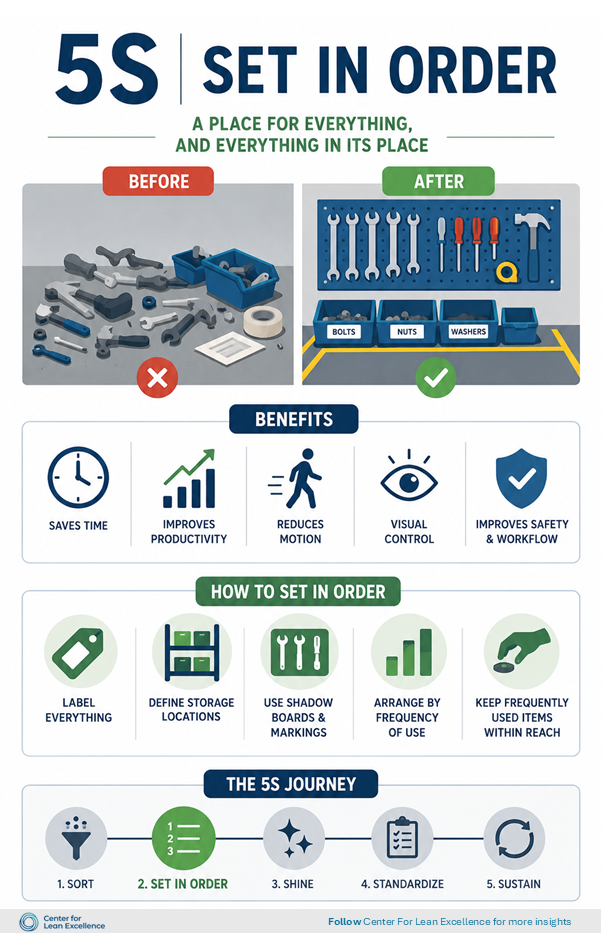
“A place for everything, and everything in its place.”
This simple phrase perfectly captures the essence of “Set in Order,” the second pillar of the 5S methodology. In many workplaces, time is not lost because employees are unskilled or inefficient. Instead, productivity suffers because tools, materials, files, and information are not organized properly. Employees spend unnecessary time searching, walking, waiting, or rearranging items that should already have a designated place.
Set in Order focuses on eliminating these inefficiencies by creating a workplace where everything is arranged logically, visually, and systematically.
What is “Set in Order”?
Set in Order is the second step of 5S, following the “Sort” stage. Once unnecessary items are removed from the workplace, the next step is to organize the remaining items so they are:
- Easy to find
- Easy to use
- Easy to return
The purpose is to ensure that every item has a clearly defined location based on its frequency of use, function, and workflow importance. When employees know exactly where to find and return tools or materials, work becomes smoother, faster, and more consistent.
This principle is widely practiced in Lean manufacturing environments because organization directly impacts efficiency and operational flow.
Why “Set in Order” Matters
A poorly organized workplace creates hidden waste every day. Employees may spend minutes searching for tools, moving unnecessary items, or walking long distances to access frequently used materials. These small inefficiencies accumulate into significant productivity losses over time.
Implementing Set in Order provides several important benefits:
Reduces Searching Time
One of the biggest workplace wastes is searching. Organized storage systems help employees locate items immediately, reducing delays and frustration.
Improves Productivity
When tools and materials are available at the right place and the right time, employees can focus more on value-adding work rather than unnecessary movement.
Minimizes Motion Waste
Unnecessary bending, reaching, walking, or turning are forms of motion waste. Proper workplace arrangement improves ergonomics and reduces fatigue.
Creates Visual Control
A visually organized workplace quickly reveals abnormalities. Missing tools, misplaced materials, or excess inventory become easy to identify.
Improves Safety and Workflow
Organized environments reduce accidents caused by clutter, blocked pathways, or improper storage. They also improve workflow continuity and discipline.
Simple Practices for Effective Set in Order
Successful implementation does not always require expensive systems. Simple visual and organizational practices can create significant improvements.
Label Everything Clearly
Labels help employees quickly identify storage locations, materials, equipment, and files. Clear labeling reduces confusion and improves consistency.
Define Storage Locations
Every item should have a designated place. This prevents tools and materials from being left randomly around the workplace.
Use Shadow Boards and Floor Markings
Shadow boards visually indicate where tools belong, while floor markings define pathways, storage zones, and work areas. These visual controls improve organization and accountability.
Arrange Based on Frequency of Use
Frequently used items should be kept close to the operator or work area, while rarely used items can be stored further away. This improves efficiency and reduces unnecessary movement.
Keep Frequently Used Items Within Reach
Workstations should be designed ergonomically so operators can access commonly used tools easily and safely.
The Real Impact of Set in Order
Many people think 5S is simply about cleaning or making the workplace look attractive. However, Set in Order goes much deeper than appearance.
A well-organized workplace improves:
- Speed
- Discipline
- Efficiency
- Employee ownership
- Process consistency
Employees develop better working habits when systems are visual and standardized. Teams become more disciplined because expectations are clear and easy to follow.
Most importantly, Set in Order helps create flow. When materials, tools, and information move smoothly through the process without delays or confusion, the entire operation becomes more efficient.
Conclusion
Set in Order is not about decoration or cleaning. It is about designing a workplace that supports productivity, reduces waste, and improves workflow. By organizing items logically and visually, organizations create environments where employees can work safely, efficiently, and confidently.
In Lean thinking, small improvements in organization often create large improvements in performance. A workplace where everything has its place is a workplace where flow, discipline, and operational excellence can truly thrive.