In quality management, Lean, and Six Sigma, the terms error and defect are often used interchangeably. However, they represent two different concepts. Understanding the distinction between them is essential for effective problem-solving, process improvement, and building a culture of quality.
What is an Error?
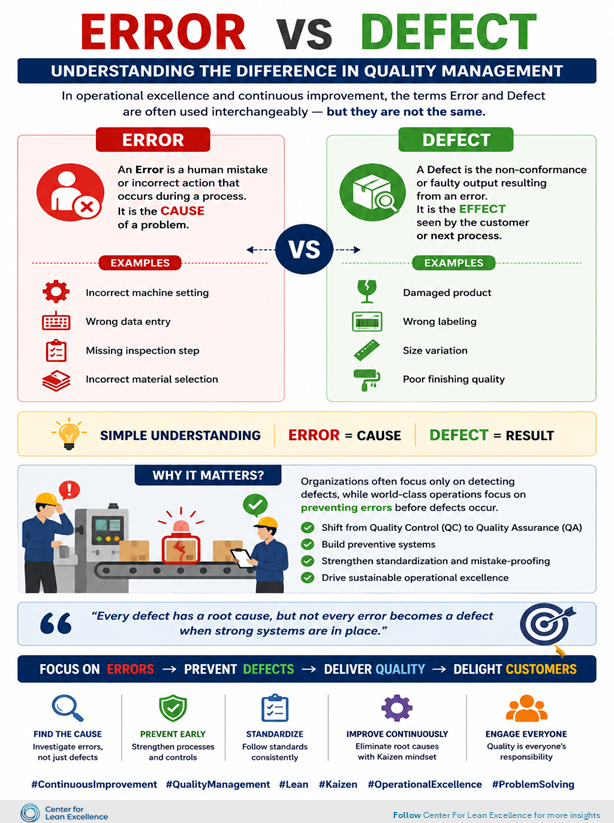
An error is a human action or decision that deviates from the correct process, procedure, or standard. It occurs when a person makes a mistake, either intentionally or unintentionally.
Errors can happen due to various reasons such as:
- Lack of training
- Misunderstanding instructions
- Fatigue or distraction
- Poor communication
- Complex processes
- Inadequate workplace conditions
For example, an operator may enter the wrong measurement into a machine, skip a required inspection step, or select an incorrect material during production. These actions are considered errors because they are deviations from the expected method.
It is important to note that an error does not always result in a problem. Sometimes errors are detected and corrected before they affect the final product or service.
What is a Defect?
A defect is a flaw, nonconformity, or failure in a product, service, or process output that does not meet customer requirements or specifications.
Unlike an error, a defect is visible in the final outcome.
Examples of defects include:
- A garment with incorrect stitching
- A product with missing components
- Incorrect labeling on a package
- A software application with a malfunctioning feature
- A customer order delivered with the wrong quantity
Defects are what customers experience and often lead to complaints, rework, returns, warranty claims, and loss of trust.
The Relationship Between Errors and Defects
A simple way to understand the relationship is:
Errors are causes, while defects are results.
An error creates the possibility of a defect. If the error is not detected and corrected in time, it may eventually become a defect.
For example:
- An operator accidentally selects the wrong fabric roll. (Error)
- The fabric is cut and sewn into garments.
- Finished garments do not meet customer specifications. (Defect)
In this case, the defect is the visible outcome of the earlier error.
However, not every error becomes a defect. Effective quality controls, inspections, and mistake-proofing systems can detect and correct errors before they reach the customer.
Why Understanding the Difference Matters
Organizations often focus only on defects because they are easier to see and measure. While defect reduction is important, eliminating defects without addressing the underlying errors only treats the symptoms rather than the root cause.
When teams understand the distinction, they can:
- Focus on prevention instead of correction
- Improve process reliability
- Reduce rework and waste
- Strengthen root cause analysis
- Increase customer satisfaction
- Build a culture of continuous improvement
Lean and Six Sigma methodologies emphasize identifying the sources of errors and designing processes that prevent them from occurring.
Preventing Errors and Defects
Several quality tools can help organizations reduce both errors and defects:
- Standardized Work
- Poka-Yoke (Mistake Proofing)
- Visual Management
- Training and Skill Development
- Process Audits
- Root Cause Analysis
- Statistical Process Control
- Continuous Improvement Activities
By addressing human and process-related errors early, organizations can significantly reduce the number of defects reaching customers.
Conclusion
Errors and defects are closely related but not the same. An error is a mistake made during a process, while a defect is the undesirable result that reaches the output. Quality excellence is achieved not only by finding defects but by preventing the errors that create them.
The most successful organizations shift their focus from detecting defects to eliminating errors at the source. When errors are prevented, defects naturally decrease, leading to higher quality, lower costs, and greater customer satisfaction.