Kanban is often presented as a simple and elegant system for controlling production flow. In theory, the concept is straightforward: produce only what is needed, when it is needed, and in the quantity needed. A pull-based system driven by customer demand sounds ideal for any operation striving for efficiency and waste reduction.
However, reality inside factories and supply chains is far more complex.
Different processes operate under different conditions. Some production areas work best in batches due to machine constraints or setup times. Other processes require continuous flow to maintain efficiency and stability. Warehouses must balance stock availability while avoiding excess inventory. Suppliers may deliver materials based on entirely different replenishment cycles. Trying to force a single Kanban method across the entire value stream often creates more problems than solutions.
This is where the concept of Hybrid Kanban becomes highly effective.
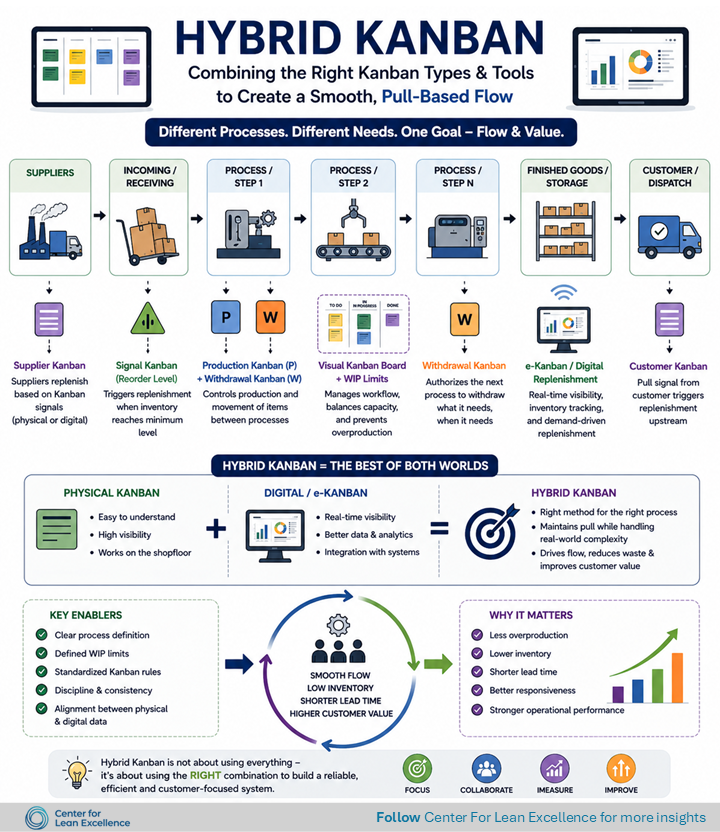
Hybrid Kanban is not about replacing traditional Kanban principles. Instead, it is about intelligently combining different Kanban approaches to suit operational realities while still maintaining the core philosophy of pull systems and flow management.
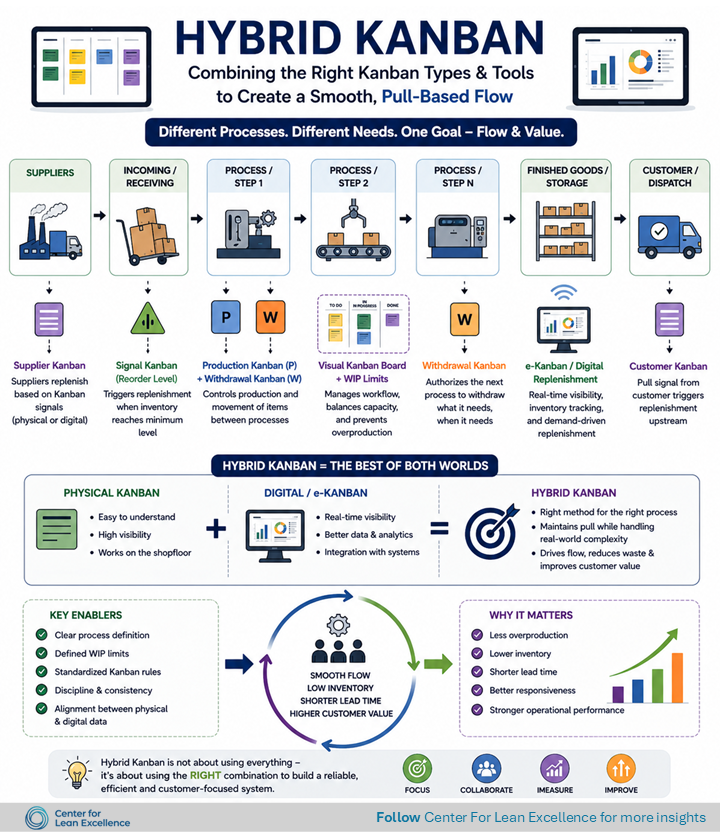
A well-designed Hybrid Kanban system may include several control mechanisms working together:
- Signal Kanban for batch-triggered processes where production starts only after reaching a defined trigger point.
- Production and Withdrawal Kanban to manage material flow between upstream and downstream operations.
- Visual Kanban boards to control Work-In-Progress (WIP) and improve shopfloor visibility.
- Electronic Kanban (e-Kanban) systems for real-time planning, tracking, and communication across departments and suppliers.
Each method serves a different purpose, but together they create a flexible and responsive operating system.
For example, a cutting department may require batch processing because of setup optimization, while sewing operations may depend on continuous flow to maintain output balance. Warehousing may use replenishment Kanban for stock control, while supplier coordination may rely on digital e-Kanban signals for accurate delivery planning. Instead of forcing one standard across all these areas, Hybrid Kanban allows organizations to apply the right control mechanism at the right point in the process.
The results can be significant.
Organizations that implement Hybrid Kanban effectively often experience better material flow, lower inventory levels, reduced waiting time, and improved responsiveness to customer demand. Because each process is managed according to its operational requirement, the entire value stream becomes more stable and synchronized.
Another major advantage is improved alignment between planning functions and shopfloor execution. In many operations, planning teams work with digital systems while production teams depend heavily on physical visual management. Hybrid Kanban bridges this gap by integrating both physical and digital controls into a single operational framework.
However, implementing Hybrid Kanban successfully requires discipline.
The flexibility of Hybrid Kanban should not become an excuse for uncontrolled processes or excessive customization. Without proper standards, the system can quickly become confusing and ineffective. Clear operating rules, defined WIP limits, replenishment logic, escalation procedures, and ownership responsibilities are essential.
Visual management also plays a critical role. Teams must be able to quickly understand production status, shortages, bottlenecks, and priorities. Whether using physical cards or electronic dashboards, visibility and simplicity remain key principles.
Equally important is maintaining alignment between digital systems and actual shopfloor conditions. A highly sophisticated e-Kanban system will fail if physical inventory accuracy is poor or if teams do not follow standard processes consistently.
Ultimately, Hybrid Kanban is not about adding complexity to operations. It is about recognizing that different processes require different control methods while still protecting the integrity of flow-based production.
The goal remains the same: deliver value with minimum waste, controlled inventory, and smooth operational flow.
In today’s manufacturing and supply chain environment, flexibility is no longer optional. Organizations that adapt their flow systems intelligently will create more resilient and responsive operations.
Hybrid Kanban achieves this by applying the right control at the right point — turning Kanban from a theoretical concept into a practical operational advantage.